Euphorbia aeruginosa var. minor

BotanicalCollector

4.9 · Premium
In Stock · Ships in 48h
$ 35.00 / plant
Attribute Option
Quantity Qty
1
Sales Type Retail, Same Batch
Product Size W6-8cm
Weight 0.15 kg
Propagation Method Seed-grown
Genus Euphorbia

Description

Scientific Name: Euphorbia aeruginosa var. minor

Geographic & Climate

  • Geographic Coordinates: The nominate species originates from the northern regions of South Africa (Limpopo Province, formerly northern Mpumalanga/Eastern Transvaal, around areas like Punda Maria). However, specific native geolocation data for this micro-variety is insufficient in authoritative databases, as Euphorbia aeruginosa var. minor is primarily recognized as a dwarf horticultural selection or stable clumping clone in cultivation.

  • Climate Classification: BSh (Hot semi-arid climate) to BWh (Hot desert climate) matching its parental lineage.

  • Habitat Characteristics: The parental species grows natively at altitudes ranging roughly between 300 to 900 meters above sea level, typically anchored in rocky slopes, gravelly soils, or shallow granitic formations under light bush shelter.

Botanical Morphology

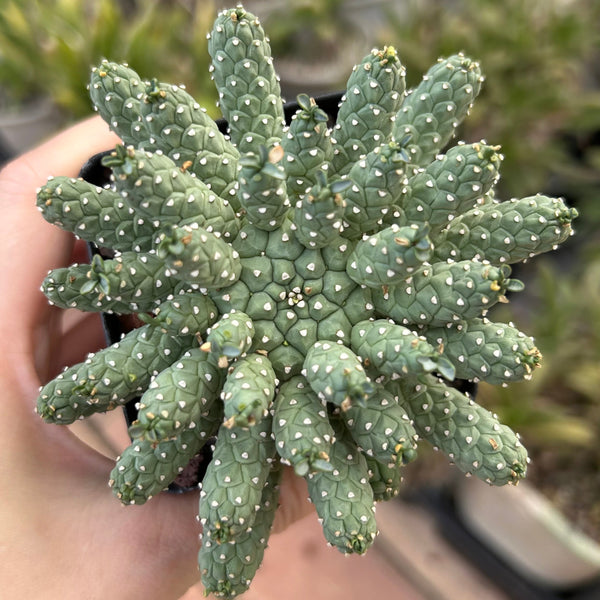
  • Diagnostic Features: Euphorbia aeruginosa var. minor is distinguished from the standard species by its markedly miniaturized, highly dense clumping architecture. It features very slender, subcylindrical, multi-angled (4–5 angled) stems that exhibit a striking verdigris (coppery, bluish-grey to aqua-blue) epidermis. Its spine shields are small and obovate, giving rise to paired, sharp, needle-like stipular spines displaying a brilliant, contrasting coppery-red to deep maroon coloration. The cyathia (false flowers) are tiny, bright golden-yellow, and form neatly aligned rows along the stem ribs.

  • Growth Habit: This variety displays a highly active basal branching habit, forming compact, cushion-like clusters. It undergoes a distinct winter dormancy period. Growth rate is slow-moderate compared to the species type. The maximum mature height rarely exceeds 15 cm (6 inches), with a maximum clump width of about 20–30 cm.

History & Etymology

  • Etymology: The genus name Euphorbia honors Euphorbus, the Greek physician to King Juba II of Numidia. The specific epithet aeruginosa derives from Latin, meaning "covered in copper rust or verdigris," explicitly referencing the distinctive patina-like coloration of the branches. The varietal name minor translates directly from Latin as "smaller," indicating its diminutive stature relative to the type species.

  • Historical Context: While Euphorbia aeruginosa was formally described by German-South African botanist Werner Rodolfo Max Schweickerdt in 1935, the var. minor designation arose later within specialist succulent cultivation and the European/US nursery trade to categorize and isolate a distinctively dwarf, highly prolific clumping form that maintains its micro-proportions even under optimal watering regimes.

Care Guide

Essential Care Tips for Thriving Plants

Light

Provide partial to full sun. Most plants thrive on direct UV exposure. Avoid placing behind window glass, as it filters out the essential UV rays needed for healthy growth.

Water

Follow the "Soak and Dry" principle. Ensure the top 2–3 cm of soil is bone dry before watering (use the finger test). Reduce frequency in winter, but do not stop watering entirely.

Temperature

The ideal range is 18–35 °C. Maintain temperatures above 5 °C during winter. Please note that temperatures below 0 °C pose a significant risk of plant death.

Humidity

Best kept at 30–50% humidity. Note: High air humidity is not a substitute for root watering. Avoid overly damp areas to prevent root rot or leggy side shoots.

Soil

A loose, well-draining medium is ideal. A mix containing 50–70% grit or mineral soil is recommended for aeration. Outdoor ground planting is also a viable option.

Fertilizer

Fertilize during repotting using Osmocote A2 slow-release fertilizer. Apply sparingly twice a year, or adjust the fertilizer type based on your specific home environment.

Planting Guide

Start Your Green Journey in 4 Steps

01

Unbox & Inspect

Carefully unpack and inspect the plant’s body and roots. We recommend taking photos or videos immediately for your records. Place it in a shaded, well-ventilated spot for 1–2 days to acclimate to its new environment.

02

Potting & Placement

After 24 hours of rest, pot the plant using slightly moistened soil. Place it in a bright, airy location to encourage recovery. Keep away from AC vents or heaters to prevent damage from temperature fluctuations.

03

First Watering

Use water that has sat for at least 24 hours. If using the damp-potting method, wait 2–3 days before the first watering. Ensure a thorough soak until water drains freely from the bottom.

04

Daily Care

Monitor leaf condition and soil moisture daily. If the soil remains damp, increase ventilation rather than watering. Proper airflow is essential to prevent root rot and ensure lasting health.