Euphorbia turbiniformis

BotanicalCollector

4.9 · Premium
In Stock · Ships in 48h
$ 30.00 / plant
Attribute Option
Quantity Qty
1
International Logistics
Unbeatable Quality
All The Help You Need
Sales Type Retail, Same Batch
Product Size W1.5-2cm
Weight 0.2 kg
Propagation Method Grafting
Genus Euphorbia

Description

Scientific Name: Euphorbia turbiniformis Chiov.

Geographic & Climate

  • Geographic Coordinates: 7°55' N to 8°05' N, 49°45' E to 49°55' E (Strictly endemic to the limestone plateaus surrounding the Eyl/Eil district in northeastern Somalia, Puntland).

  • Climate Classification: Tropical Desert Climate (BWh under the Köppen classification / Arid lowland zone).

  • Habitat Characteristics: Found at an altitude of approximately 300 meters above sea level on weathered, alkaline limestone cliffs and bare plateaus. It is a highly cryptic, semi-subterranean species that grows buried up to its flat apex in calcareous grit and lithic skeletal soils, typically sheltered beneath sparse, low-growing xerophytic woody shrubs. Rainfall is extremely scarce, volatile, and strictly seasonal.

Botanical Morphology

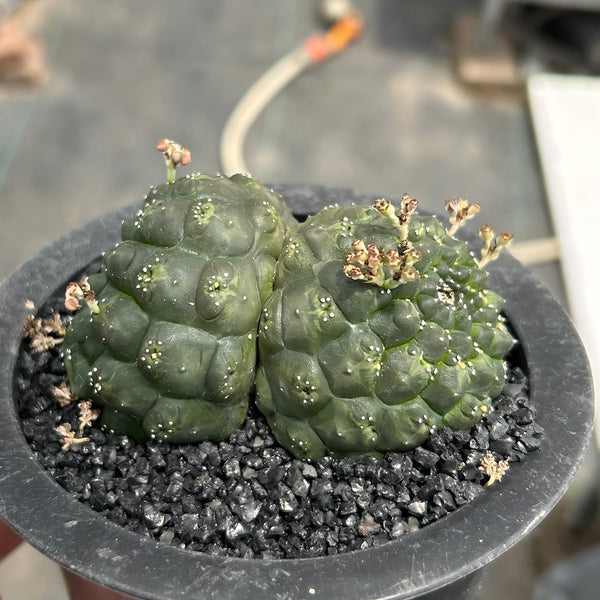
  • Diagnostic Features: A dwarf, un-armed, and completely spineless globose succulent. The body is characteristically turbiniform (top-shaped) to spherical, anchored by a brief, obconic subterranean caudex measuring roughly 4 cm in height and 6 to 8 cm in diameter. The apex is distinctly depressed and slightly woolly. Its glabrous, smooth epidermis displays an intricate, highly symmetric tessellated (checkered) mosaic geometry formed by flat polygonal plates divided by shallow, crisp grooves. True spines are entirely absent; spine-shields are drastically reduced to tiny, microscopic vestigial scales located at the center of each geometric tile. Inflorescences are produced directly from the depressed apex as extremely reduced cymes (up to 5 mm long) bearing tiny, dull yellow cyathia.

  • Growth Habit: Exhibits an exceptionally slow metabolic and growth rate. To survive the harsh climatic extremes of its native habitat, it undergoes an amphitermic double dormancy period—resting during the peak heat of summer and the dry cold of winter. Ultimate mature dimensions rarely exceed 4 cm in height by 8 cm in diameter. It retains a strict solitary growth habit under wild conditions.

History & Etymology

  • Etymology: The genus name Euphorbia honors Euphorbus, the ancient Greek physician to King Juba II of Numidia, who documented the medicinal and hazardous attributes of the genus's milky latex. The specific epithet turbiniformis combines the Latin turbo (meaning "a spinning top") and forma (meaning "shape" or "form"), directly referencing the plant's distinctive obconic, top-like morphology.

  • Historical Context: First documented during early Italian scientific expeditions to the Horn of Africa and officially described by Emilio Chiovenda in 1929 (Flora Somala). Following its initial description, decades of geopolitical instability and the isolation of the Puntland deserts completely sealed off the habitat, leading the international botanical community to fear the species had gone extinct in the wild. In 1968, after nearly 40 years without a trace, the legendary succulent botanist John J. Lavranos successfully rediscovered wild populations near Eyl. It remains a holy grail specimen for advanced collectors due to its striking convergent evolution with the Mexican cactus Astrophytum asterias.

Care Guide

Essential Care Tips for Thriving Plants

Light

Provide partial to full sun. Most plants thrive on direct UV exposure. Avoid placing behind window glass, as it filters out the essential UV rays needed for healthy growth.

Water

Follow the "Soak and Dry" principle. Ensure the top 2–3 cm of soil is bone dry before watering (use the finger test). Reduce frequency in winter, but do not stop watering entirely.

Temperature

The ideal range is 18–35 °C. Maintain temperatures above 5 °C during winter. Please note that temperatures below 0 °C pose a significant risk of plant death.

Humidity

Best kept at 30–50% humidity. Note: High air humidity is not a substitute for root watering. Avoid overly damp areas to prevent root rot or leggy side shoots.

Soil

A loose, well-draining medium is ideal. A mix containing 50–70% grit or mineral soil is recommended for aeration. Outdoor ground planting is also a viable option.

Fertilizer

Fertilize during repotting using Osmocote A2 slow-release fertilizer. Apply sparingly twice a year, or adjust the fertilizer type based on your specific home environment.

Planting Guide

Start Your Green Journey in 4 Steps

01

Unbox & Inspect

Carefully unpack and inspect the plant’s body and roots. We recommend taking photos or videos immediately for your records. Place it in a shaded, well-ventilated spot for 1–2 days to acclimate to its new environment.

02

Potting & Placement

After 24 hours of rest, pot the plant using slightly moistened soil. Place it in a bright, airy location to encourage recovery. Keep away from AC vents or heaters to prevent damage from temperature fluctuations.

03

First Watering

Use water that has sat for at least 24 hours. If using the damp-potting method, wait 2–3 days before the first watering. Ensure a thorough soak until water drains freely from the bottom.

04

Daily Care

Monitor leaf condition and soil moisture daily. If the soil remains damp, increase ventilation rather than watering. Proper airflow is essential to prevent root rot and ensure lasting health.