Euphorbia gottlebei

BotanicalCollector

4.9 · Premium
In Stock · Ships in 48h
$ 45.00 / plant
Quantity Qty
1
International Logistics
Unbeatable Quality
All The Help You Need
Sales Type Retail, Same Batch
Product Size H6cm
Weight 0.2 kg
Propagation Method Seed-grown
Genus Euphorbia

Description

Geographic & Climate

  • Geographic Coordinates: 22°50' S to 22°58' S, 44°15' E to 44°30' E (Restricted strictly to the Type Locality: Fiherenana River valley, west of Sakaraha, Toliara Province, Southwest Madagascar).

  • Climate Classification: Subarid tropical/subtropical dry climate (BSh transitioning to BWh under Köppen classification), characterized by prolonged drought and a very brief, erratic wet season.

  • Habitat Characteristics: Occurs exclusively on steep, heavily weathered limestone cliffs and crags within subarid deciduous thorny thickets. Found at altitudes ranging between 200 to 500 meters above sea level. It thrives in porous, alkaline, mineral-rich lithosols collected within rock crevices, experiencing intense sun exposure and acute water runoff.

Botanical Morphology

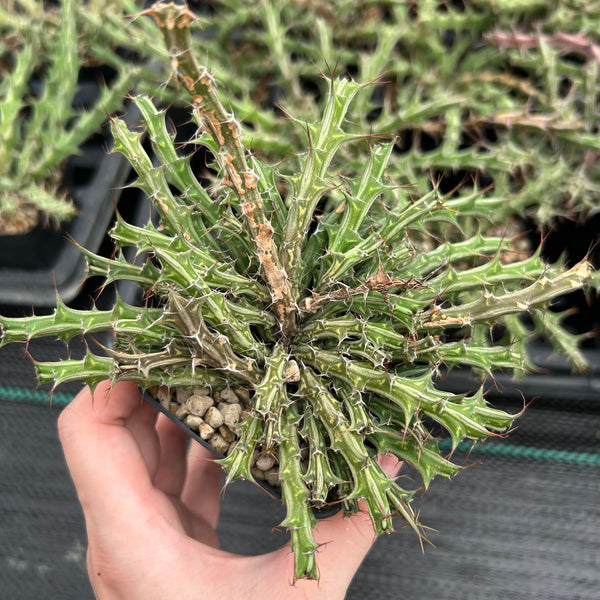
  • Diagnostic Features: A distinctively lax, intricately branched semi-succulent shrub characterized by primary stems up to 2 cm thick. Its armor consists of densely arranged, short, and highly rigid stipular spines up to 1.5 cm long, featuring an noticeably wide, swollen base. A key taxonomic indicator is the presence of short, modified lateral spurs (up to 3 cm long) emerging directly between the primary spines. The cyathia (false flowers) are small, borne in clusters of 4 to 16 below the branch tips, and subtended by a pair of highly conspicuous, petal-like, brilliant carmine-red (or fiery orange-red) cyathophylls (bracts).

  • Growth Habit: Winter deciduous (shedding leaves during the coolest, driest operational phase from July to August). It exhibits a relatively slow growth rate, structurally adapted to form a sprawling, heavily armed multi-stemmed canopy. In its native habitat, it reaches a maximum mature height of 1.5 meters ($150\text{ cm}$).

History & Etymology

  • Etymology: The genus name Euphorbia honors Euphorbus, the Greek physician to King Juba II of Numidia. The specific epithet gottlebei commemorates Gottlebe, an avid plant collector or associate of the German botanist Werner Rauh, who assisted in securing or bringing attention to Malagasy succulent flora.

  • Historical Context: Euphorbia gottlebei was formally described relatively recently in 1992 by the renowned German botanist Werner Rauh in the Cactus and Succulent Journal (Los Angeles). Collected from an extremely restricted micro-endemic zone along the Fiherenana drainage, it rapidly gained legendary status in specialized ex-situ collections due to its intense bract coloration and dramatic "Crown of Thorns" architecture, contrasting against its slender, needle-thin seasonal foliage.

Care Guide

Essential Care Tips for Thriving Plants

Light

Provide partial to full sun. Most plants thrive on direct UV exposure. Avoid placing behind window glass, as it filters out the essential UV rays needed for healthy growth.

Water

Follow the "Soak and Dry" principle. Ensure the top 2–3 cm of soil is bone dry before watering (use the finger test). Reduce frequency in winter, but do not stop watering entirely.

Temperature

The ideal range is 18–35 °C. Maintain temperatures above 5 °C during winter. Please note that temperatures below 0 °C pose a significant risk of plant death.

Humidity

Best kept at 30–50% humidity. Note: High air humidity is not a substitute for root watering. Avoid overly damp areas to prevent root rot or leggy side shoots.

Soil

A loose, well-draining medium is ideal. A mix containing 50–70% grit or mineral soil is recommended for aeration. Outdoor ground planting is also a viable option.

Fertilizer

Fertilize during repotting using Osmocote A2 slow-release fertilizer. Apply sparingly twice a year, or adjust the fertilizer type based on your specific home environment.

Planting Guide

Start Your Green Journey in 4 Steps

01

Unbox & Inspect

Carefully unpack and inspect the plant’s body and roots. We recommend taking photos or videos immediately for your records. Place it in a shaded, well-ventilated spot for 1–2 days to acclimate to its new environment.

02

Potting & Placement

After 24 hours of rest, pot the plant using slightly moistened soil. Place it in a bright, airy location to encourage recovery. Keep away from AC vents or heaters to prevent damage from temperature fluctuations.

03

First Watering

Use water that has sat for at least 24 hours. If using the damp-potting method, wait 2–3 days before the first watering. Ensure a thorough soak until water drains freely from the bottom.

04

Daily Care

Monitor leaf condition and soil moisture daily. If the soil remains damp, increase ventilation rather than watering. Proper airflow is essential to prevent root rot and ensure lasting health.