Important Notice: Low-Temperature Shipping — Read Before Ordering

Notice on Low-Temperature Shipping

Recently, temperatures have been gradually dropping in various regions, and some plants require insulated packaging for shipping. When placing an order, you can check the estimated delivery time on the order page. Below are the packaging arrangements for different temperature conditions:

If the temperature at your address is expected to remain below -5°C throughout the estimated delivery period, please do not place an order.

If the minimum temperature at your address during the estimated delivery period is between 0°C and 5°C, your order will be shipped in an insulated box, and an additional shipping fee will be required. The specific fee will be notified by email. You may pay the additional shipping fee, or apply to us for a refund.

If the minimum temperature at your address during the estimated delivery period is above 5°C, no insulated box will be arranged, and your order will be shipped as normal.

Note: For some cold-sensitive plants, we will send email reminders depending on the situation.

Thank you all for your support and trust!

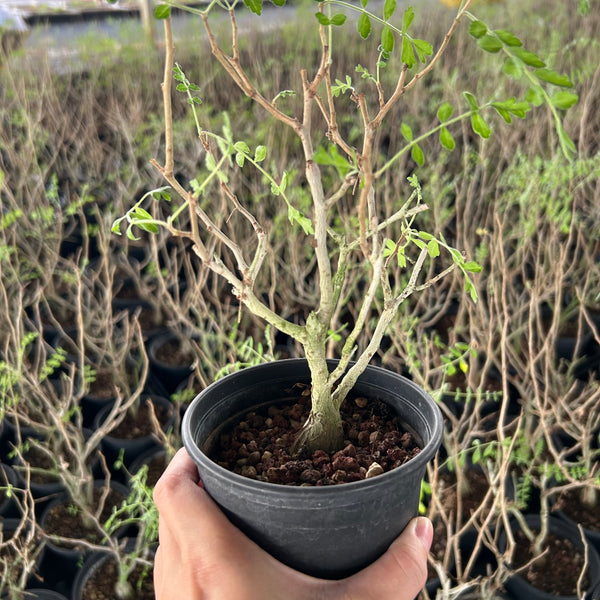
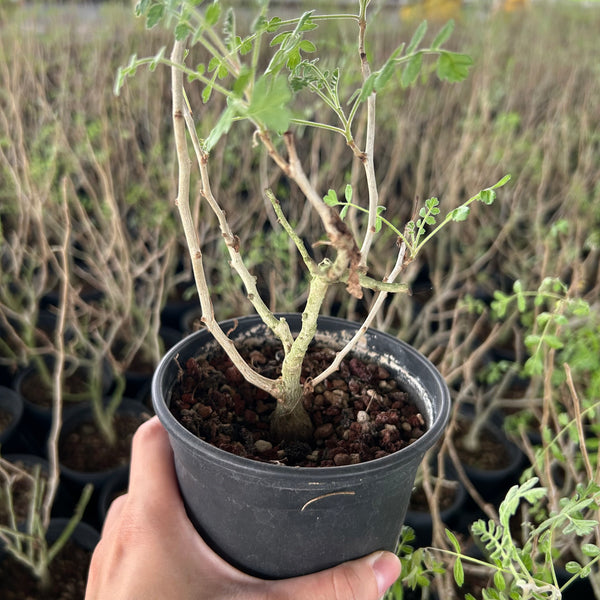
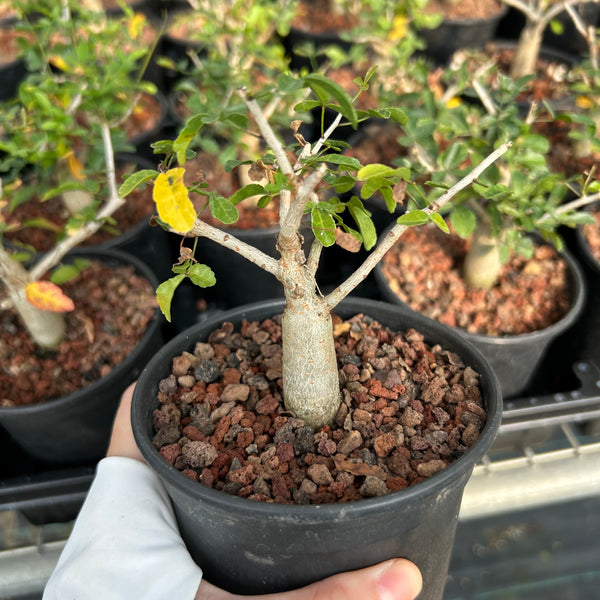
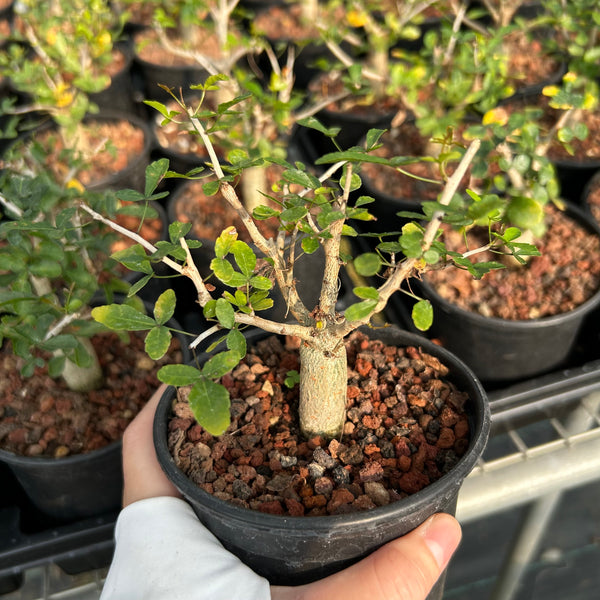
Bursera laxiflora

Burseraceae · Bursera
$ 40.00 / plant
Plant selection You'll receive a similar plant. Appearance may vary. In stock · 50 available
Quantity
Sales Type Retail, Same Batch
Plant size W1cm
Packaged Weight Actual packaged weight varies by product and root system. 0.2 kg
Propagation Method Seed-grown

Cataloged as

Description

Scientific Name: Bursera laxiflora S.Watson

Geographic & Climate

Geographic Coordinates
Type: Palmer 280, collected in 1887 "in ravines about Guaymas", Sonora, Mexico (vernacular name "Copal"); preserved at K as K000081107. The protologue states only that Guaymas lies "in lat. 28° N"; the Kew label gives the locality name, not coordinates. The Guaymas area georeferences to c. 27.9–28.0°N, 110.9–111.0°W, but no exact type-locality coordinate is published — insufficient native data for this taxon at type-coordinate level; no point coordinate is invented. Documented native range (IUCN 2019): Mexico — Baja California, Baja California Sur, Chihuahua, Sinaloa and Sonora; WFO additionally maps Mexico Northeast and Mexico Northwest. Secondary accounts record Tiburón Island and Socorro Island, but these island records are not repeated in the IUCN native-state list. POWO and LLIFLE publish no species-level coordinates.

Climate Classification
No species-level Köppen code is published by POWO or LLIFLE (no verifiable dedicated LLIFLE page exists for this species): insufficient native data for this taxon on that point. The type locality lies in the Sonoran Desert lowlands of central Sonora. Watson recorded that Palmer's June–November 1887 season was very dry, with only occasional light showers from August; IUCN lists the habitat types as Forest, Shrubland and Desert.

Habitat Characteristics
Ravines and rocky slopes about Guaymas (protologue); rocky hillsides, bajadas and dry tropical thorn scrub on skeletal, well-drained substrates (secondary floristic accounts). Elevation 0–1,000 m (IUCN). IUCN records 10–12 locations with a continuing decline in habitat quality; assessed Near Threatened (B2ab(ii,iii)) in 2019, with residential/tourism development, agriculture, ranching and mining as principal threats.

Botanical Morphology

Diagnostic Features
Small tree, trunk 6 inches to 1 foot in diameter (c. 15–30 cm). Leaves pinnate, sparingly pubescent with short, mostly spreading hairs; rachis narrowly winged; leaflets 2–4 pairs, thin, ovate to oblong, mostly obtuse, entire or usually with 1–4 (rarely 6) blunt teeth, 3–9 lines (c. 6–19 mm) long. Peduncles axillary, solitary, very slender, 1–4 inches (c. 2.5–10 cm) long, 1–3-flowered, often bearing 1–3 simple foliaceous bracts; pedicels c. 6 lines (c. 12 mm); sepals narrow, c. 1 line. Fruit obovate, narrowed at the base, somewhat compressed, 2-valved, c. 4 lines (c. 8 mm) long. Modern accounts add red bark (vs. grey bark in the closely related B. filicifolia), 5–9 leaflets and ovoid flattened drupes. All parts yield an aromatic copal resin.

Growth Habit
Deciduous, drought-adapted small tree; horticultural accounts give 3–6 m tall, 2–4 m spread and moderate growth, though the protologue describes a much smaller tree. Leaves are shed through the dry season and flush after summer rains (secondary source; flowering-time reports conflict — spring in one cultivation account, June–August in another). USDA zones 9–11; propagated from seed or cuttings.

History & Etymology

Etymology
Bursera honours Joachim Burser (1583–1639), German physician and botanist. laxiflora derives from Latin laxus ("loose, lax") + florus ("flowered"), referring to the long, slender, few-flowered peduncles.

Historical Context
Sereno Watson described the species in 1889 from Edward Palmer's 1887 Guaymas collections; that season yielded 415 native species, of which 89 were new to science, despite severe drought. Joseph Rose transferred it to Terebinthus (1909) and Elaphrium (1911); Kuntze's 1891 combination is not the accepted name. The vernacular "Copal" reflects the resin traditionally used locally. Wild populations are now Near Threatened.

Care Guide

Essential Care Tips for Thriving Plants

Light

Provide partial to full sun. Most plants thrive on direct UV exposure. Avoid placing behind window glass, as it filters out the essential UV rays needed for healthy growth.

Water

Follow the "Soak and Dry" principle. Ensure the top 2–3 cm of soil is bone dry before watering (use the finger test). Reduce frequency in winter, but do not stop watering entirely.

Temperature

The ideal range is 18–35 °C. Maintain temperatures above 5 °C during winter. Please note that temperatures below 0 °C pose a significant risk of plant death.

Humidity

Best kept at 30–50% humidity. Note: High air humidity is not a substitute for root watering. Avoid overly damp areas to prevent root rot or leggy side shoots.

Soil

A loose, well-draining medium is ideal. A mix containing 50–70% grit or mineral soil is recommended for aeration. Outdoor ground planting is also a viable option.

Fertilizer

Fertilize during repotting using Osmocote A2 slow-release fertilizer. Apply sparingly twice a year, or adjust the fertilizer type based on your specific home environment.

Planting Guide

Start Your Green Journey in 4 Steps

Unbox & Inspect

Carefully unpack and inspect the plant’s body and roots. We recommend taking photos or videos immediately for your records. Place it in a shaded, well-ventilated spot for 1–2 days to acclimate to its new environment.

Potting & Placement

After 24 hours of rest, pot the plant using slightly moistened soil. Place it in a bright, airy location to encourage recovery. Keep away from AC vents or heaters to prevent damage from temperature fluctuations.

First Watering

Use water that has sat for at least 24 hours. If using the damp-potting method, wait 2–3 days before the first watering. Ensure a thorough soak until water drains freely from the bottom.

Daily Care

Monitor leaf condition and soil moisture daily. If the soil remains damp, increase ventilation rather than watering. Proper airflow is essential to prevent root rot and ensure lasting health.