Boophone disticha

BotanicalCollector

4.9 · Premium
In Stock · Ships in 48h
$ 26.00 / plant
Attribute Option
Quantity Qty
1
Sales Type Retail, Same Batch
Product Size W1.5-2cm
Weight 0.2 kg
Propagation Method Seed-grown
Genus Boophone

Description

Origin

Boophone disticha (L.f.) Herb. is native to a wide swathe of southern Africa, ranging from the Western Cape of South Africa northwards through the Free State, KwaZulu-Natal, the drier interior of Namibia, Botswana, and into Zimbabwe and Mozambique (Africa). The genus was segregated from Haemanthus in the nineteenth century by the English botanist William Herbert, and the species has long been familiar to both European and African horticulturists. In habitat, large populations are typical, but the plant is toxic and traditionally used in arrow poisons, which has limited its handling rather than its distribution.

Habitat

In its natural environment, this species is a specialist of open grassland and rocky slopes in summer-rainfall regions, where it grows in well-drained loams and stony soils on quartzite, dolerite, and sandstone substrates at altitudes of roughly 200–2000 meters above sea level. Rainfall arrives in summer, followed by a cool dry winter during which the bulb is fully deciduous and the leaves die back. Wild populations often flower gregariously after fire or extended drought, an adaptive response that synchronises mass blooming events across entire hillsides.

Description

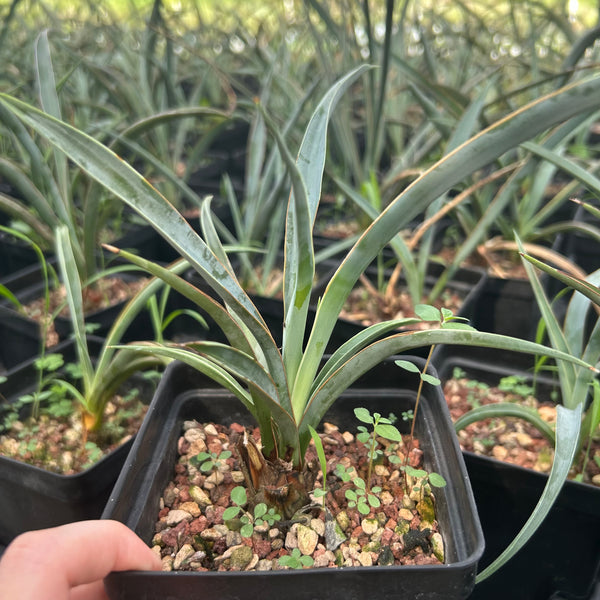
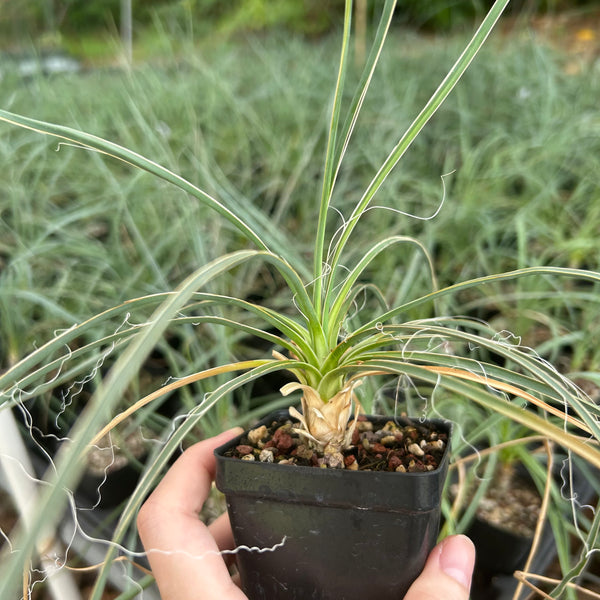
Boophone disticha is a large winter-dormant bulbous amaryllid whose toxic alkaloid chemistry and very symmetrical fan of leaves have made it both feared and admired throughout its range.

Bulb & Size: The bulb is large, broadly ovoid, and often partly exposed above the soil, sheathed in layers of dry, papery, tan-coloured tunics. Mature bulbs can reach 15–20 cm across and produce offsets slowly to form clumps over many decades.

Roots: A dense, fleshy root system emerges from the basal plate of the bulb each growing season, drawing moisture from the warm summer soils and retracting as the leaves yellow in autumn.

Leaves: The leaves are the species' signature feature. They are arranged in a distinctive distichous, that is, two-ranked, fan-shaped plane, broad, strap-shaped, glaucous blue-green to grey-green, and often with a crimped or wavy margin. New leaves are produced in spring and die back completely in winter dormancy.

Flowers: In late winter to early spring, before the new leaves appear, a stout peduncle emerges carrying a dense, rounded umbel of many small, fragrant, pink to deep carmine flowers, with conspicuous exserted stamens. A second distinct horticultural form produces pure white flowers.

Cultivation: Plant in a deep pot in a well-drained, humus-rich loam with the bulb neck just above the soil. Water freely from spring through autumn while in leaf, withhold water almost completely in winter dormancy, and grow in full sun. All parts are toxic and the plant must be handled with gloves.

Care Guide

Essential Care Tips for Thriving Plants

Light

Provide partial to full sun. Most plants thrive on direct UV exposure. Avoid placing behind window glass, as it filters out the essential UV rays needed for healthy growth.

Water

Follow the "Soak and Dry" principle. Ensure the top 2–3 cm of soil is bone dry before watering (use the finger test). Reduce frequency in winter, but do not stop watering entirely.

Temperature

The ideal range is 18–35 °C. Maintain temperatures above 5 °C during winter. Please note that temperatures below 0 °C pose a significant risk of plant death.

Humidity

Best kept at 30–50% humidity. Note: High air humidity is not a substitute for root watering. Avoid overly damp areas to prevent root rot or leggy side shoots.

Soil

A loose, well-draining medium is ideal. A mix containing 50–70% grit or mineral soil is recommended for aeration. Outdoor ground planting is also a viable option.

Fertilizer

Fertilize during repotting using Osmocote A2 slow-release fertilizer. Apply sparingly twice a year, or adjust the fertilizer type based on your specific home environment.

Planting Guide

Start Your Green Journey in 4 Steps

01

Unbox & Inspect

Carefully unpack and inspect the plant’s body and roots. We recommend taking photos or videos immediately for your records. Place it in a shaded, well-ventilated spot for 1–2 days to acclimate to its new environment.

02

Potting & Placement

After 24 hours of rest, pot the plant using slightly moistened soil. Place it in a bright, airy location to encourage recovery. Keep away from AC vents or heaters to prevent damage from temperature fluctuations.

03

First Watering

Use water that has sat for at least 24 hours. If using the damp-potting method, wait 2–3 days before the first watering. Ensure a thorough soak until water drains freely from the bottom.

04

Daily Care

Monitor leaf condition and soil moisture daily. If the soil remains damp, increase ventilation rather than watering. Proper airflow is essential to prevent root rot and ensure lasting health.