Pachypodium namaquanum

BotanicalCollector

4.9 · Premium
In Stock · Ships in 48h
$ 80.00 / plant
Attribute Option
Quantity Qty
1
International Logistics
Unbeatable Quality
All The Help You Need
Sales Type Retail, WYSIWYG
Product Size W3.5cm
Weight 0.2 kg
Propagation Method Seed-grown
Genus Pachypodium

Description

Origin

Pachypodium namaquanum is native to the Richtersveld in the Northern Cape of South Africa and across the Orange River into southern Namibia. It is a strictly protected species, listed under CITES Appendix I, which reflects its rarity and the high level of international conservation effort required to protect it from habitat loss and poaching.

Habitat

In its natural environment, this species thrives in one of the harshest deserts on Earth—the Gariep Centre of endemism. It grows on precipitous, rocky hillsides and black volcanic ridges (primarily gneiss and schist) in the succulent Karoo. The habitat is characterized by extreme aridity, scorching summer heat, and sparse winter rainfall. Interestingly, the plants almost always tilt their heads (apices) 10–30° towards the north, an evolutionary adaptation to maximize the absorption of winter sunlight for photosynthesis.

Description

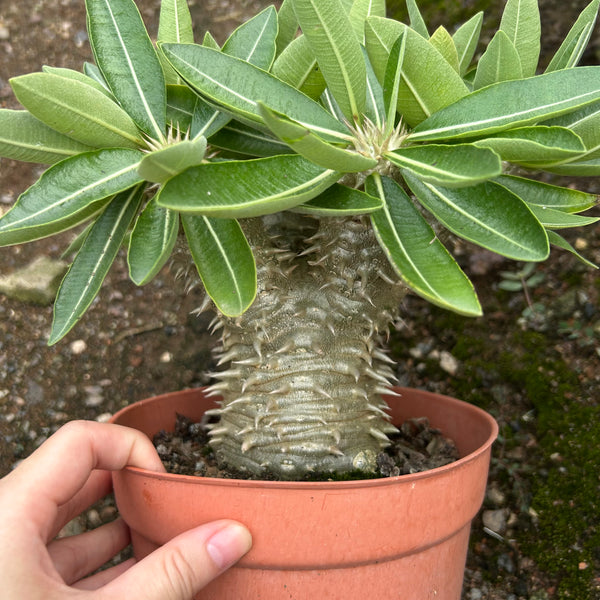
Pachypodium namaquanum is a "heavyweight" among succulent collectors, known for its majestic, monolithic presence and incredibly slow growth.

  • Stem (Caudex): It typically grows as a solitary, unbranched, columnar trunk that can reach 1.5 to 4 meters in height over centuries. The stem is tapered, silver-gray, and densely armored with stiff, sharp spines (stipular spines) arranged in a neat, geometric spiral.

  • Foliage: During its winter growing season, it produces a dense, crown-like rosette of leaves at the very top of the stem. The leaves are distinctively undulated (wavy-edged), velvet-soft, and covered in fine silvery hairs to reflect heat.

  • Flowers: It produces spectacular, tubular, bell-shaped flowers that are velvety-red or brownish-maroon on the inside and yellowish-green on the outside. These blooms emerge from the center of the leaf rosette.

  • Cultivation: This is a "Winter Grower," which distinguishes it from many other Pachypodium species. It requires maximum sunlight and an extremely mineral-rich, fast-draining substrate (granite grit or volcanic rock). It is very sensitive to overwatering during the hot summer months when it is dormant and must be kept dry during this period.

Care Guide

Essential Care Tips for Thriving Plants

Light

Provide partial to full sun. Most plants thrive on direct UV exposure. Avoid placing behind window glass, as it filters out the essential UV rays needed for healthy growth.

Water

Follow the "Soak and Dry" principle. Ensure the top 2–3 cm of soil is bone dry before watering (use the finger test). Reduce frequency in winter, but do not stop watering entirely.

Temperature

The ideal range is 18–35 °C. Maintain temperatures above 5 °C during winter. Please note that temperatures below 0 °C pose a significant risk of plant death.

Humidity

Best kept at 30–50% humidity. Note: High air humidity is not a substitute for root watering. Avoid overly damp areas to prevent root rot or leggy side shoots.

Soil

A loose, well-draining medium is ideal. A mix containing 50–70% grit or mineral soil is recommended for aeration. Outdoor ground planting is also a viable option.

Fertilizer

Fertilize during repotting using Osmocote A2 slow-release fertilizer. Apply sparingly twice a year, or adjust the fertilizer type based on your specific home environment.

Planting Guide

Start Your Green Journey in 4 Steps

01

Unbox & Inspect

Carefully unpack and inspect the plant’s body and roots. We recommend taking photos or videos immediately for your records. Place it in a shaded, well-ventilated spot for 1–2 days to acclimate to its new environment.

02

Potting & Placement

After 24 hours of rest, pot the plant using slightly moistened soil. Place it in a bright, airy location to encourage recovery. Keep away from AC vents or heaters to prevent damage from temperature fluctuations.

03

First Watering

Use water that has sat for at least 24 hours. If using the damp-potting method, wait 2–3 days before the first watering. Ensure a thorough soak until water drains freely from the bottom.

04

Daily Care

Monitor leaf condition and soil moisture daily. If the soil remains damp, increase ventilation rather than watering. Proper airflow is essential to prevent root rot and ensure lasting health.