Dendrosicyos socotranus

BotanicalCollector

4.9 · Premium
In Stock · Ships in 48h
$ 40.00 / plant
Attribute Option
Quantity Qty
1
Sales Type Retail, Same Batch
Product Size W2.5-3cm
Weight 0.2 kg
Propagation Method Seed-grown
Genus Dendrosicyos

Description

Scientific Name: Dendrosicyos socotranus Balf.f. (often cited as Dendrosicyos socotrana)

Geographic & Climate

  • Geographic Coordinates: Latitude 12°19' N to 12°42' N, Longitude 53°18' E to 54°32' E (Endemic to Socotra Island, Yemen; Type Locality: Schweinfurth 243).

  • Climate Classification: Hot Desert Climate (BWh under the Köppen-Geiger system).

  • Habitat Characteristics: Found at elevations from sea level up to 500 meters. It typically grows on dry limestone plains, rocky hillsides, and coastal plains, often associated with Croton socotranus and Adenium obesum subsp. socotranum. The substrate is highly alkaline, well-drained, limestone-derived gritty soil. Precipitation is low and highly erratic, heavily influenced by seasonal monsoons (averaging 150 to 250 mm annually).

Botanical Morphology

  • Diagnostic Features:

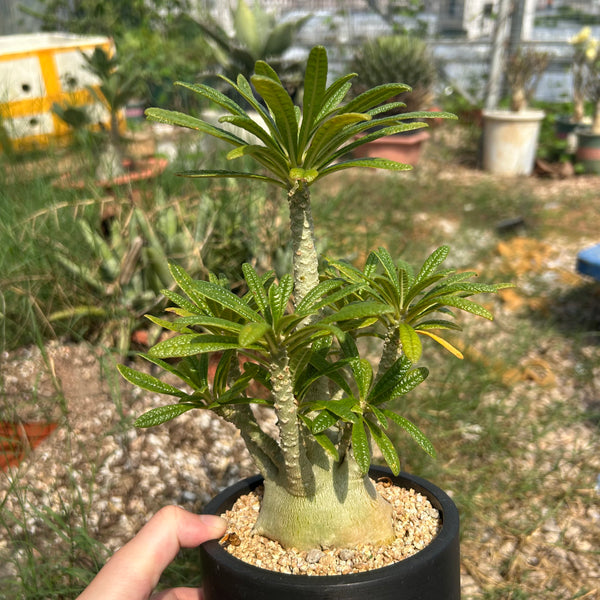
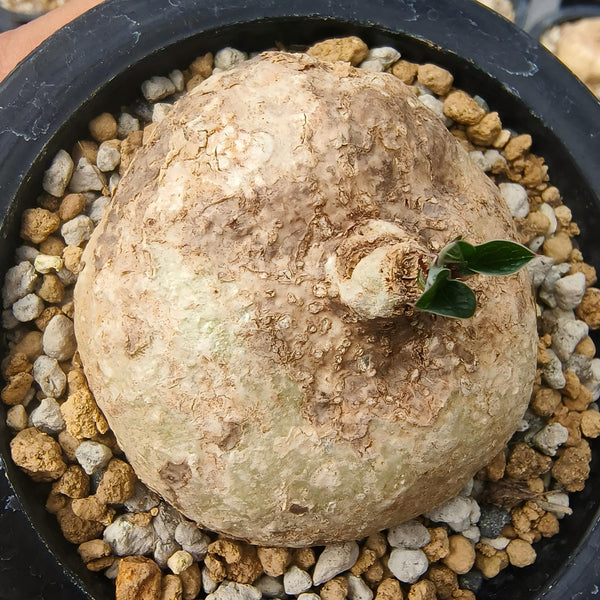
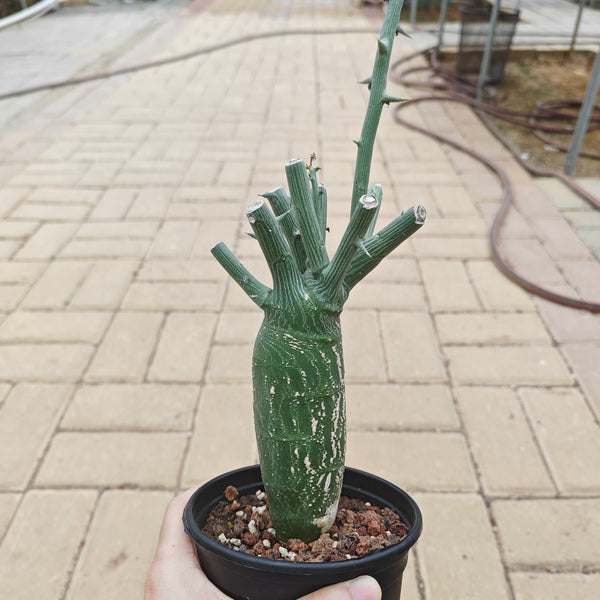
    • It is the only known species in the family Cucurbitaceae that grows in a true arborescent (tree) form, characterized by a massively swollen, pachycaul, bottle-shaped trunk filled with moist, fibrous parenchyma tissue instead of solid wood.

    • Lacks the climbing tendrils typical of almost all other cucurbits.

    • Leaves are simple, petiolate, ovate-cordate, deeply and pedately 4-6-lobed, with a serrate margin and covered with fine, rigid, prickly bristles. They emit an unpleasant odor when crushed.

    • Flowers are monoecious, yellow, around 2.5 to 3 cm in diameter, produced in axillary clusters.

    • Fruit is a cylindrical, smooth to slightly glandular-setose berry (about 3 to 4 cm long) that matures to bright orange-red, containing compressed, 6 mm long seeds.

  • Growth Habit:

    • Dormancy: Drought-deciduous. Drops its leaves during extremely hot, dry seasons and enters a semi-dormant state in late autumn/winter under cultivation if temperatures drop.

    • Growth Rate: Extremely slow under natural arid conditions, though moderately fast in warm, wet greenhouse cultivation.

    • Final Size: Can reach 3 to 6 meters in height, with a trunk diameter of up to 1 meter at the base.

History & Etymology

  • Etymology:

    • The genus name Dendrosicyos is derived from the Ancient Greek words dendron (δένδρον), meaning "tree," and sikyos (σίκυος), meaning "cucumber" — literally translating to "cucumber tree."

    • The specific epithet socotranus refers directly to its native island of Socotra.

  • Historical Context: The species was first scientifically collected and described by the Scottish botanist Isaac Bayley Balfour in 1882 during his historic expedition to the Socotra Archipelago. For decades, it has fascinated botanists as an evolutionary anomaly — a giant succulent tree emerging from a family otherwise dominated by soft-stemmed, climbing herbaceous vines.

Care Guide

Essential Care Tips for Thriving Plants

Light

Provide partial to full sun. Most plants thrive on direct UV exposure. Avoid placing behind window glass, as it filters out the essential UV rays needed for healthy growth.

Water

Follow the "Soak and Dry" principle. Ensure the top 2–3 cm of soil is bone dry before watering (use the finger test). Reduce frequency in winter, but do not stop watering entirely.

Temperature

The ideal range is 18–35 °C. Maintain temperatures above 5 °C during winter. Please note that temperatures below 0 °C pose a significant risk of plant death.

Humidity

Best kept at 30–50% humidity. Note: High air humidity is not a substitute for root watering. Avoid overly damp areas to prevent root rot or leggy side shoots.

Soil

A loose, well-draining medium is ideal. A mix containing 50–70% grit or mineral soil is recommended for aeration. Outdoor ground planting is also a viable option.

Fertilizer

Fertilize during repotting using Osmocote A2 slow-release fertilizer. Apply sparingly twice a year, or adjust the fertilizer type based on your specific home environment.

Planting Guide

Start Your Green Journey in 4 Steps

01

Unbox & Inspect

Carefully unpack and inspect the plant’s body and roots. We recommend taking photos or videos immediately for your records. Place it in a shaded, well-ventilated spot for 1–2 days to acclimate to its new environment.

02

Potting & Placement

After 24 hours of rest, pot the plant using slightly moistened soil. Place it in a bright, airy location to encourage recovery. Keep away from AC vents or heaters to prevent damage from temperature fluctuations.

03

First Watering

Use water that has sat for at least 24 hours. If using the damp-potting method, wait 2–3 days before the first watering. Ensure a thorough soak until water drains freely from the bottom.

04

Daily Care

Monitor leaf condition and soil moisture daily. If the soil remains damp, increase ventilation rather than watering. Proper airflow is essential to prevent root rot and ensure lasting health.